

SMS Fraud Detection That Reaches Further Than Your Security Stack
CheckTxt analyzes suspicious text messages in real time and stops impersonation attacks before customers act on them.
The FBI’s newly released Internet Crime Report shows $20.8 billion in fraud losses in 2025 — a 26% increase from 2024.
Fraud has moved beyond the enterprise perimeter
Traditional security protects networks, applications, and infrastructure. It wasn’t built for what happens when fraud reaches your customers directly — on personal devices, through trusted channels, in moments where speed matters and trust is assumed.
CheckTxt was built for exactly that moment.
35%
feel it is the responsibility of the enterprise to keep people safe
Protection where fraud actually happens—outside security systems
Watch CheckTxt CEO Jack Marshall check a real toll violation smishing scam — live, in real time. This is exactly what your bank customers, employees, or end users experience when they verify a suspicious message.
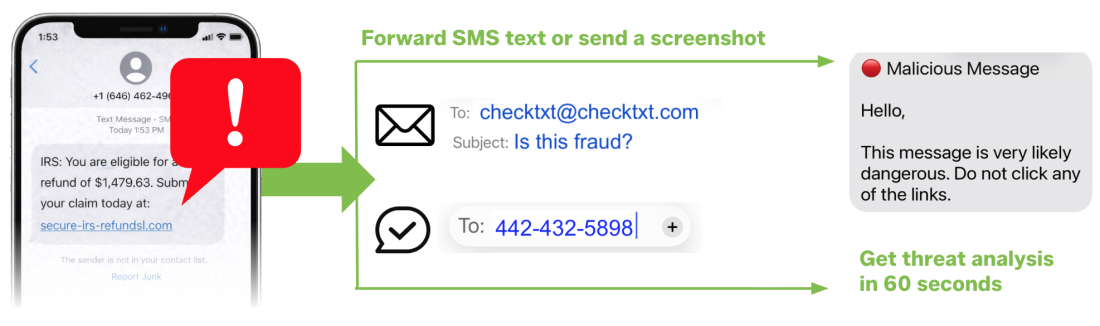
It’s so easy to check if that message is fraudulent.
- Forward a text or send a screenshot → 442-432-5898
- Forward an email or send a screenshot → [email protected]
Forward any suspicious text.
Verdict returned in under 60 seconds.
CheckTxt deploys beyond your current security stack
Built for the industries fraudsters target most
Extend SMS fraud protection to employees and customers beyond the enterprise perimeter. Integrates with SIEM, no MDM needed.
Detect SMS impersonation campaigns targeting bank customers before they cause fraud.
Add SMS fraud protection to your managed services portfolio. Multi-tenant, zero deployment complexity, predictable recurring revenue.
Latest Blog Posts

Text Message Scams: What the FBI’s Data Reveals
Every conversation about fraud prevention eventually comes back to email. Phishing simulations, secure gateways, employee training — all of it pointed at the inbox. And while security teams have spent years hardening that channel, attackers have quietly shifted to one that most enterprise stacks don’t touch at all.
Text

AI Can Now Impersonate Your Brand Perfectly and Your Customers Can’t Tell the Difference.
AI has made brand impersonation texts indistinguishable from real ones. Learn why community and regional banks are being specifically targeted, why your security stack can’t stop it, and what proactive protection looks like.

Bank Impersonation Attacks: How They Work and How Banks Can Stop Them
Bank impersonation attacks are targeting customers through SMS at scale. Learn how these campaigns work, why they bypass existing security controls, and what banks can do to stop them before fraud occurs.
Frequently Asked Questions
How does CheckTxt deploy to customers at scale?
CheckTxt is built on a B2B2C model — meaning the organizations that need it most deploy it directly to the people attackers target.
Whether it’s SMS fraud protection for banks, SMS fraud protection for enterprises, or SMS fraud protection for MSSPs delivering it to their clients, the model is the same: real-time fraud protection reaches customers and employees directly, with no app, no onboarding, and no workflow changes required. Protection scales instantly across an entire customer base — without adding support overhead.
What does CheckTxt do?
CheckTxt provides real-time SMS fraud detection and protection for enterprises and their customers. When a customer receives a suspicious text message, they can simply forward it or send a screenshot. CheckTxt analyzes the message in real time and returns a clear fraud verdict—before the message is trusted, clicked, or acted on.
As messages are analyzed, CheckTxt identifies patterns across attacks, helping organizations detect coordinated SMS fraud campaigns early. This gives security and fraud teams visibility into customer-targeted attacks that traditional security tools can’t see—and the ability to stop scams before they spread.
How is CheckTxt different from traditional security tools?
Most security tools are designed to protect internal systems—networks, applications, and employee environments. CheckTxt focuses on what happens outside the enterprise perimeter when fraud reaches customers directly through SMS.
CheckTxt delivers real-time SMS fraud protection at the moment a message is received, not after damage has already occurred. This allows organizations to stop scams earlier, reduce investigation and support effort, and protect customer trust—without changing how people communicate or requiring apps, logins, or onboarding.
To see how this works in practice, explore CheckTxt’s SMS fraud protection for banks and SMS fraud protection for enterprises.
How can organizations stop fraud before it scales?
Stopping fraud early requires visibility into suspicious messages as they reach customers and employees, not after losses have already occurred. Early detection makes it possible to recognize emerging patterns, identify coordinated activity, and take action while the impact is still limited.
Early SMS threat detection for enterprises plays a critical role here. Individual messages may seem isolated, but together they reveal how fraud campaigns spread. Connecting signals across text and email helps organizations intervene sooner—before fraud escalates into larger financial, operational, or trust issues.
Why can’t traditional security tools stop messaging fraud?
Traditional security tools are good at protecting internal systems, but they often lose visibility once fraud reaches customers and employees through everyday texts and emails. Closing that gap requires a different approach—one that addresses enterprise messaging fraud at the point messages are received, not after damage has already occurred.
By analyzing suspicious messages and identifying patterns across text and email, organizations gain earlier insight into how fraud campaigns form and spread. This allows teams to act sooner, reduce losses, ease the burden on security and support teams, and prevent isolated incidents from escalating into larger enterprise risks.
Why do companies need protection against messaging-based fraud?
Traditional security tools are designed to protect internal systems like networks, applications, and endpoints. Messaging fraud, however, often reaches customers and employees directly through text and email—outside those systems—where traditional controls have little visibility.
Addressing this gap requires earlier insight into suspicious messages and the ability to recognize patterns across channels. This is why approaches like SMS threat detection matter—individual messages can reveal broader fraud activity when analyzed together. Connecting those signals across text and email makes it possible to interrupt campaigns earlier, without requiring people to change how they communicate.